
The War after World War Two in the Dutch East Indies

From East Indies Camp Archives

Bersiap

The large majority of the Dutch in and outside the Dutch East Indies did not realize that the situation in the colony had changed drastically as a result of the war. They blindly assumed that Dutch colonial rule would be restored. They did not take the Indonesian declaration of independence of 17 August seriously. On the contrary: many saw the Republic of Indonesia as a monstrosity conceived by the Japanese and proclaimed by native collaborators.

However, the Dutch were not in a strong position. The British troops that had landed on Java had no intention of brushing the Republic aside. The only purpose of their arrival was to evacuate the internees and to disarm and take away the Japanese. The British commander on Java, lieutenant-general Christison, expressed the intention of bringing the Dutch and the Indonesians to the negotiating table.

Meanwhile, the Japanese troops wanted to be rid of their responsibility for maintaining order as quickly as possible. They started to withdraw into camps they had already prepared (‘self-internment’). The Japanese furthermore handed over weapons to the Indonesian youth groups, the so-called ‘pemudas’, on a large scale; often voluntarily, but sometimes under duress. A chaotic situation ensued in which no single party was able to adequately fill the power vacuum left by the war.

As it became increasingly clear that the Dutch authorities were busy preparing their return to the Dutch East Indies, the nationalist forces rebelled more and more. Sukarno and the other nationalist leaders were unable to fully control their young and excitable followers. Hundreds of local Indonesian combat groups, formed ad hoc and armed with Japanese weapons, often operated without any central leadership and without any control from the older leaders.

The final three months of 1945, the so-called bersiap period (bersiap means ‘be ready’), were characterized by violence, chaos and anarchy. There were street fights and former Dutch internees in and outside the camps were systematically attacked and fired upon. Assaults, kidnapping and murder took place everywhere, and the Chinese and Indo-Europeans in particular were targeted by radical Indonesian nationalists.

The Indos outside the camps were in an extremely vulnerable position, while the internees in the camps were protected by the Japanese and/or the British. Hundreds of men, women and children were murdered in gruesome ways. In addition tens of thousands of Dutch people were, probably partly for their own safety, (re)interned by the Republic of Indonesia, often in camps in the interior of Java. Their number is estimated at around 46,000 persons.

The British could not prevent the pemudas starting to view them as being pro-Dutch also; gradually they, too, became targets of the Indonesian youths. Sometimes Japanese were victims of the violence. In most places the attitude of the Japanese was quite ambivalent, but in general they guarded the camps well, and in Semarang, led by local commander Kido, they intervened strongly to rescue the threatened Dutchmen.

In cities like Surabaya, Semarang and Bandung the British, British-Indian and Japanese soldiers fought fierce battles with the nationalist combat groups before they could start evacuating the former internment camps. In Surabaya the British had to fight street to street for three weeks before they gained control of the city. The former internees in Ambarawa, Banjubiru and Magelang in Central Java – mainly women and children – were evacuated by the British to Semarang with great difficulty. In Bandung the southern part of the city had to be evacuated to make a better defence of the northern part possible.

The refugee problem was considerable everywhere. Thousands of former internees in East and Central Java were therefore evacuated to Batavia, Singapore, Bangkok, the British-ruled Indies, Ceylon, Australia or the Netherlands. As a result of the hasty evacuations and sustained fighting, a degree of peace was re-established in the British-controlled key areas in early 1946. Even after the bersiap period there were skirmishes in many places, but the violence was not as intense or widespread as it had been in the final months of 1945.

How many people died on the Indonesian side during the bersiap period is difficult to determine. Estimates range from 30,000 to 100,000 pemudas killed on Java. Up to December 1946 the British and British-Indian forces suffered 655 dead (600 of whom on Java), 1,663 injured (1,420 on Java) and 320 missing persons (all missing on Java). The conflict with the Indonesian nationalists cost the Japanese army 402 dead, 239 injured, and 88 missing men. The number of Dutch and Indo victims of the bersiap is not known exactly; estimates range from 3,500 to 20,000 dead. A total number of approximately 5,500 victims is probably most realistic.

The nationalist violence did not focus exclusively on the Dutch and Chinese. Thousands of Indonesians also became victims of the revolutionary violence. Indonesian civil servants and the native elite in particular were targeted. In the Dutch period, but also under the Japanese, these officials and this elite had served as pillars for the ruling regime. In addition to an anti-colonial uprising, this was therefore also a social revolution.

The shock of the bersiap convinced many Indo-Europeans that there would be no room for them in an independent Indonesia. After the transfer of sovereignty in December 1949 the large majority of Indo-Europeans left their native country.

In November 1945 in the Netherlands, young men, mostly volunteers, were being trained for deployment to the Dutch East Indies. Their purpose  would be to protect the exhausted civilians from the bloody attacks of the extremists and restore order wherever possible. A young man named Gerrit Vermeulen from Renswoude was deployed to Soerabaja, on Java – the city where we lived when the war broke out, where my father worked on the Naval Base, and where we were first incarcerated by the Japanese in 1942.

Gerrit Vermeulen wrote letters to his mother and friends back in the Netherlands about his experiences as a soldier in this very dangerous time right after the war: the Bersiap. I have translated his interesting letters and will post them on my Blog in the weeks to come.

Stay tuned!

I welcome your comments.

Until Next time,

Ronny
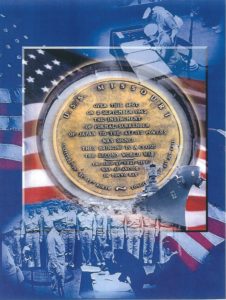
September 2, 1945: Signing of the Instrument of Surrender

USS Missouri, Tokyo Bay, Japan

Representatives of the United States, Republic of China, United Kingdom, Union of Soviet Socialist Republic, Commonwealth of Australia, Dominion of Canada, Provisional Government of the French Republic, the Kingdom of the Netherlands, Dominion of New Zealand and the Supreme Commander for the Allied Powers, General Douglas Mac Arthur, gathered on the deck of the USS Missouri to accept the Document of Surrender on September 2, 1945, at 09:08 a.m. signed By Command and in behalf of the Emperor of Japan and the Japanese Government and By Command and in behalf of the Japanese Imperial General Headquarters.Deck Seal USS Missouri

A large commemorative brass seal was placed in the deck of the ship on the spot where the Instrument of Surrender was signed.

Fifty years later, in the harbor of Bremerton, WA, I stood on the deck of the USS Missouri, looking down at the seal, reading the words “THUS BRINGING TO A CLOSE THE SECOND WORLD WAR”.

It was then that I fully realized that this moment in time, fifty years ago, was the beginning of a new life for me. Life as it was meant to be, free of hunger, free of fear, free of pain and scary punishments, full of joy and love and family. It brought tears to my eyes and gratitude in my heart for the heroic men who fought for us, and for my courageous mother who kept believing in God’s goodness and in the day the war would end, until finally that day arrived and we were free!

I will hang out the flag every year on September 2nd, as I celebrate Life.


I welcome your comments!

Until next time,

Ronny


Japan’s Revisionists have Different View of World War Two (May 8, 2016 War History Online)

Japan’s revisionists are a driving force behind a different version of what happened during World War Two. Slave labor, torture and sex slaves for the Japanese troops are all versions of war-time Japan according to most of the world, except for a small but growing group of people in Japan itself.
One of the most prominent revisionists is Toshio Tamogami, (https://en.wikipedia.org/wiki/Toshio_Tamogami) who was the chief of staff for the Japanese Air Force. Even though he is educated and civil, he believes in a version of Japan’s role and actions during the war that differs from the mainstream. What is interesting is that the rhetoric is becoming increasingly popular in Japan, and especially amongst its youth, who are getting fed up with their country constantly having to say sorry to China and Korea.
Tamogami isn’t just happy to sit silently either, he ran for the position of governor of Tokyo, and while he didn’t win he came in fourth with more than half a million votes. Nearly a quarter of those votes were from people under 30 years old.
Tamogami says that the Allies and victors of World War Two have forced a version of events onto the people of Japan and says that Japan should stand on its own two feet and write its own history.
In his version of events, Tamogami says that Japan was not aggressive, but was instead fighting for freedom against white imperialists who had dominated the Asian region for hundreds of years.
He talks of being proud of Japan’s role in fighting back and trying to evade rule by European nations. He also does not corroborate that Japan inflicted atrocities on its fellow Asian people. He calls Japan’s invasion of Korea an ‘investment’ in Korea, along with Taiwan and Manchuria, the BBC News (www.bbc.com/news/world-asia-33754932) reports.
When asked about Japan’s invasion of China and in particular the documented killings at Nanjing in 1937, Tamogami says that it is untrue and that there are no eyewitness accounts. Further when pushed on the use of Korean women as prostitutes for Japanese troops he says it is a total fabrication. Tamogami is not alone and many nationalists in Japan are joining up to this version of events.

Meanwhile Japan’s current Prime Minister, Shinzo Abe, has been “apologizing for the actions of his nation during the war”. Although when it comes to the Korean women, he says Japan’s military never recruited them to specifically service the country’s troops and that they acted of their own accord.

(This is what Abe did say during his visit to the Washington WWII Memorial: he expressed being moved by the “lost dreams” and “lost futures of young Americans”. He also said that history was “harsh” and that a lot that was done “cannot be undone”. He mentioned he felt “deep repentance in his heart” and offered, with “profound respect”, his “eternal condolences to the souls of all American people that were lost during WWII.” He typified the post-war feelings of Japan as one of “deep remorse” over the suffering of people in Asian countries during the war from which Japan “should not avert its eyes”.)

Can you imagine what the history books will say about World War Two in the Pacific 100 years from now, when all surviving victims of the Japanese death camps, all surviving comfort women, all surviving military, all eyewitnesses have passed away?

I welcome your comments!

Until next time,

Ronny

The Aftermath of World War Two in the Pacific

One Year of Active Duty in Postwar Japan – Nagasaki, 1945

nag2

His name was Everett White (1926 – 2012). He enlisted in the Navy on his 18th birthday, June 23, 1944. His basic training in San Diego was followed by landing craft training on Coronado Island. This is his story.

When the war ended on August 15, 1945 I was in Guam, in the outer harbor, on the APB Kingfish, LST, with a flotilla. That evening we were told that Japan had surrendered, and for the first time we were able to lift the “black out” restriction that we had to maintain during the war. There was a blinding display of lights that night as the whole armada of ships of every size lit up in celebration.

My first duty was in Nagasaki where I witnessed the tremendous fear that the Japanese citizens had when they first encountered the occupying American forces. They would dive into a ditch to protect themselves from probable attack and/or torture when they saw our people. When they found out that they were not going to be killed or tortured they were quite relieved. Some of the citizens I met there had severe incendiary bomb facial scarring.

Port_of_Sasebo_viewed_from_Mount_YumihariIn Nagasaki they off-loaded 300 marines. I worked in this area for seven months. I worked with a boat crew of twelve who were taking cargo off ships. I escorted the marines to the many little atoll islands off Nagasaki as they checked radiation levels. One day we repatriated a group of interned Australian nuns from one of the islands. Upon landing they spent the first three weeks in what they called a “repatriation hotel” that was used in pre-war Japan as a “hotel” to inspect visitors to the island for possible disease.

My crew patrolled the harbor after curfew. We usually had three Japanese with us on these forays. Local Japanese fished at night and our orders were to make sure they were observing curfew (martial law). One night I was not accompanied by Japanese interpreters, and I noticed that when my boat approached the fishermen, they scurried back to their homes. I knew they were scared to death of being caught. So that evening I got off, alone, at the shore of the village and walked around the silent homes. The next night I returned with an interpreter and told them they could go about their business since they needed the food they procured by fishing.

When my tour in Nagasaki had ended I left for Toyko to be sent home. However, while there, they informed me that my tour had been extended because they were short of experienced personnel to drive landing craft boats. So I traveled by train 1200 miles from Yakuska, on Honshu, the main island, to Kagoshima on Kyushu, the southern island. Here I worked with a Japanese 40 foot tug boat and 2 LCMs, guiding ships through the 100 yard opening in the jetty wall. At times we would steer around an active volcano that was spewing red hot lava into the bay. I was also on hand to observe the surly Japanese as they were off-loaded from the ships coming back from the China that they had occupied. I saw they were lining up to get sprayed and possibly deloused, before they traveled back to their original home areas. Kagoshima was not built as a port; so it was a one-at-a-time offloading. The jetty was a massive construction where women would descend 50 steps to do their laundry.

There were about 15 to 20 sailors in the barracks during my time there. High security was no longer a major consideration. One night we were awakened at 2 a.m. and told, “We gotta go out to the ship. There’s a riot.” We quickly dressed. The ship was jammed with returning Japanese. The agitation appeared to be a personal dispute resolved by the death of one of the Japanese soldiers. By the time we arrived the danger of a riot had abated. That was a good thing since we only had a small force. We would have been significantly outnumbered had any of us been attacked.

While stationed there, I was alarmed by a possible break-in at one of the Quonset huts one night. I warned the trespasser, a Japanese man, who then attacked me and cut my face in several places. I was able to restrain the man but later regretted interrupting him in his break-in. The poor guy was probably hungry. Innocent civilians everywhere suffered the ravages of war. Postwar Japan was no different than anywhere else.

Looking forward to your Comments,

Until next time,

Ronny

Reflections on the Final Days of World War Two

Hirohito’s Unconditional Surrender Speech: the End of the War?

On August 14 the Japanese Emperor delivered his surrender speech – the war was over; but was it? Not for us in Camp Halmahera. For a full week, in our camp and many other camps, women and children were still dying. We did not know anything about the outside world. My mother wrote in her secret diary:

Book pictures 012

“Paula couldn’t sit or stand any more, and the situation couldn’t last long, but we were living life a day at a time. We just existed. We remained inside our house. We were a tightly knit trinity. The little ones had only me and I had only them. We had no more field labor, not even a roll call. We were so tired; we frequently just lay on our mattresses. We couldn’t have done anymore work anyway. Deaths became normal daily events all around us.

On the night of August 22, 1945, I crossed out another day on my little calendar. It would be the last time.”

If you haven’t read my books about our lives in the Japanese concentration camps on Java, please know that you can order the latest version of my book Rising from the Shadow of the Sun – A Story of Love, Survival and Joy from Amazon all over the world, in print and for your Kindle.

To be Continued

I welcome your comments!

Ronny


Reflections on the Final Days of World War Two

The Attacks in August 1945

For several months, the U.S. had dropped more than 63 million leaflets across Japan warning civilians of air raids. Leaflet texts were prepared by recent Japanese prisoners of war because they were thought to be the best choice “to appeal to their compatriots.” It is very likely that Hiroshima was leafleted in late July or early August, as survivor accounts talk about a delivery of leaflets a few days before the atomic bomb was dropped. The warnings were not effective. The Japanese regarded the leaflet messages as truthful, but anyone who was caught in possession of one was arrested.

Potsdam Declaration

On July 26, 1945, Allied leaders issued the Potsdam Declaration outlining terms of surrender for Japan. It was presented as an ultimatum and stated that without a surrender, the Allies would attack Japan, resulting in “the inevitable and complete destruction of the Japanese armed forces and just as inevitably the utter devastation of the Japanese homeland.” On July 28, Japanese papers reported that the declaration had been rejected by the Japanese government. Emperor Hirohito, who was waiting for a Soviet reply to a request for help, made no move to change the government position.

Hiroshima was the primary target of the first nuclear bombing mission on August 6, with Kokura and Nagasaki as alternative targets. Having been fully briefed, the 393d Bombardment Squadron B-29 Enola Gay, piloted by Paul Tibbets, took off from North Field, Tinian, about six hours’ flight time from Japan. The Enola Gay (named after Tibbets’ mother) was preceded by two B-29 weather scouts and accompanied by two other B-29s, one to carry instrumentation and one to take photographs.

At 08:09 Tibbets started his bomb run and handed control over to his bombardier. Instead of prior to departure, the bomb was armed, but activated in flight to minimize the risks during takeoff. The release at 08:15 (Hiroshima time) went as planned, and Little Boy took 44.4 seconds to fall from the aircraft flying at about 31,000 feet (9,400 m) to a detonation height of about 1,900 feet (580 m) above the city. Enola Gay traveled 11.5 mi (18.5 km) before it felt the shock waves from the blast.

After the Hiroshima bombing, Truman issued a statement announcing the use of the new weapon. Truman then warned Japan: “If they do not now accept our terms, they may expect a rain of ruin from the air, the like of which has never been seen on this earth.”

The Japanese government did not react.

On August 5 the Soviet Foreign Minister informed Tokyo of the Soviet Union’s unilateral abrogation of the Soviet–Japanese Neutrality Pact.

On August 7, a day after Hiroshima was destroyed, the Chief of the Naval General Staff and the cabinet estimated that no more than one or two additional bombs could be readied, so they decided to endure the remaining attacks, acknowledging “there would be more destruction but the war would go on”.  American Magic Codebreakers intercepted the cabinet’s messages.

At two minutes past midnight on August 9, Tokyo time, Soviet infantry, armor, and air forces launched the Manchurian Strategic Offensive Operation. Four hours later, word reached Tokyo of the Soviet Union’s official declaration of war.

Since there was no indication of Japan surrendering, President Truman and his advisers decided to proceed with dropping another bomb, which could be ready by August 11. When Tibbets pointed to weather reports indicating poor flying conditions on that day due to a storm, the date was changed to August 9.

I realize the tragic significance of the atomic bomb … It is an awful responsibility which has come to us … We thank God that it has come to us, instead of to our enemies; and we pray that He may guide us to use it in His ways and for His purposes.
— President Harry S. Truman, August 9, 1945

At 03:49 on the morning of August 9, 1945, Bockscar, flown by Sweeney’s crew, carried Fat Man, with Kokura as the primary target and Nagasaki the secondary target. The mission plan for the second attack was nearly identical to that of the Hiroshima mission, with two B-29s flying an hour ahead as weather scouts and two additional B-29s in Sweeney’s flight for instrumentation and photographic support of the mission. Sweeney took off with his weapon already armed but with the electrical safety plugs still engaged.

After three runs over the city, and with fuel running low because of a failed fuel pump, they headed for their secondary target, Nagasaki. At 11:01, a last-minute break in the clouds over Nagasaki allowed Bockscar’s bombardier to visually sight the target as ordered. The Fat Man weapon was dropped over the city’s industrial valley and exploded 47 seconds later at 1,650 ± 33 ft (503 ± 10 m), above a tennis court, slightly off the target.

On August 9 Hirohito ordered his closest advisor to “quickly control the situation … because the Soviet Union has declared war against us.” He then held an Imperial conference during which he authorized minister Shigenori Tōgō to notify the Allies that Japan would accept their terms on one condition, that the declaration “does not comprise any demand which prejudices the prerogatives of His Majesty as a Sovereign ruler.”

On August 12, the Emperor informed the imperial family of his decision to surrender. Hirohito recorded on August 14 his capitulation announcement which was broadcast to the Japanese nation the next day despite a short rebellion by militarists opposed to the surrender (see my previous BlogPost).

In his declaration, without mentioning the Soviets’ attack as the main factor for surrender, Hirohito referred to the atomic bombings: “Moreover, the enemy now possesses a new and terrible weapon with the power to destroy many innocent lives and do incalculable damage. Should we continue to fight, not only would it result in an ultimate collapse and obliteration of the Japanese nation, but also it would lead to the total extinction of human civilization. This is the reason why We have ordered the acceptance of the provisions of the Joint Declaration of the Powers.”

Days of Victory

“Today the guns are silent. A great tragedy has ended. A great victory has been won. The skies no longer rain death — the seas bear only commerce — men everywhere walk upright in the sunlight. The entire world is quietly at peace. The holy mission has been completed… And so, my fellow countrymen, today I report to you that your sons and daughters have served you well and faithfully.”
— General Douglas MacArthur in a broadcast following the surrender of Japan on August 15, 1945

I welcome your Comments!

Ronny Herman de Jong

Reflections on the Final Days of World War Two

Above and below the decks of the USS Missouri (The Sun, September 1995)

The battleship USS Missouri, still in camouflage paint, was a shadow knifing through the wartime Pacific on the night of August 10, 1945, heading for Tokyo Bay, when the first, tentative word came that Japan had offered to surrender.

Inside the ship’s warrior, off-duty officers were viewing a Tarzan movie featuring Johnny Weissmuller and Brenda Joyce when the exec was notified of the Japanese offer about 9:05 p.m. A few minutes later he returned to his seat and the movie continued without further interruption.

But later, word slowly began to circulate around the 887-foot dreadnought, flagship of Adm. William F. “Bull” Halsey’s Third Fleet, that the long, devastating world war might be drawing to a close.

Messages were received, via Navy radio frequencies and the Army News Service, confirming the initial report that the Japanese had made a surrender offer through the Swiss government, but that the Allies had not yet responded.

Up in his shipboard quarters, Adm. Halsey received the news with characteristic bluntness. Turning to his chief of staff, Rear Adm. Robert B. Carney, he was reported to have remarked “Have we got enough fuel to turn around and hit the Japanese once more before they quit?”

Finally, about 11 p.m., the ship’s chaplain read the Army News Service press release to the entire crew over the general announcing system.

Outwardly, nothing much changed. As usual since the start of World War II, the ship and her battle group continued on course in battle formation, displaying not a single light that would betray their position to enemy forces as they steamed under a pale cuticle of a new moon.

But inside the battleship’s 17-inch thick steel hide, the mood of the officers and crew began to change almost imperceptibly. Of course, non of the grizzled salts aboard ship wanted to show much emotion, especially since they realized the surrender offer, if true, would have little impact on them. After all, there were still watches to stand and gun mounts to man. Those in their sacks just rolled over, and those on watch downed another mug of high-octane Navy coffee.

By the next day, however, the hope that the war might actually be ending became a little harder to conceal, even for the Mighty Mo’s saltiest veterans.
Radio operators aboard ship were pumped for whatever bits of information they might happen to have about the status of the Japanese surrender offer. But the radiomen, as usual, weren’t talking – and probably didn’t know much anyway.

The uncertainty – was the Navy still at war or was peace at hand? – was especially hard on Third Fleet planners, who had to prepare simultaneously for both contingencies. The frustrating rumors continued and the ship continued with the rest of the battle group toward the main Japanese island of Honshū as fleet meteorologists nervously watched an approaching typhoon.

Meanwhile, in the Imperial Palace, Emperor Hirohito had reluctantly prepared his surrender speech. But a group of rebels, led by Hatanaka, planned a coup d’état to prevent the surrender. Around 21:30 on August 14, Hatanaka’s rebels set their plan into motion and spent the next several hours fruitlessly searching for the recordings of the surrender speech. When they did not find it, within an hour before the emperor’s broadcast, sometime around 11:00, August 15, Hatanaka placed his pistol to his forehead, and shot himself.

USS Missouri entered Tokyo Bay early on 29 August to prepare for the signing by Japan of the official Instrument of Surrender on September 2, 1945.

I welcome your Comments!

Ronny Herman de Jong

Released: Interviews in Dutch and English

In January and August 1993, I was interviewed about my book, In the Shadow of the Sun (1992). All these years, those interviews have languished on VHS tapes in one storage compartment or another.

In the Shadow of the Sun was one of the first accounts in the English language about the brutal treatment of women and children by the Japanese in concentration camps in Asia during World War II.

Recently a friend and I were able to transfer the interviews from VHS to YouTube. So now for the first time, you can watch and listen to both videos here.

January 1993 TV interview, AVRO Service Salon, Hilversum, The Netherlands

August 1993 interview, KGMB News, Honolulu, Hawai’i

I hope you will enjoy watching and listening to both of them.

Harvey

Sunup Rotary Club of Prescott Presentation

March 05, 2016 by Ronny

The Sunup Rotary Club of Prescott has invited Ronny Herman de Jong to be the guest speaker for their morning Program

on Wednesday, March 09, 2016

at Hotel St. Michael

at 6:45 a.m.

A Power Point Presentation will highlight Ronny’s years in Japanese captivity during World War Two and cameos of her life after the war.

Signed Copies of her books Rising from the Shadow of the Sun and Survivors of WWII in the Pacific will be available for purchase.